How Health Claims Spread Further Than the Evidence Behind Them
Contents
When the Source Gets Left Behind
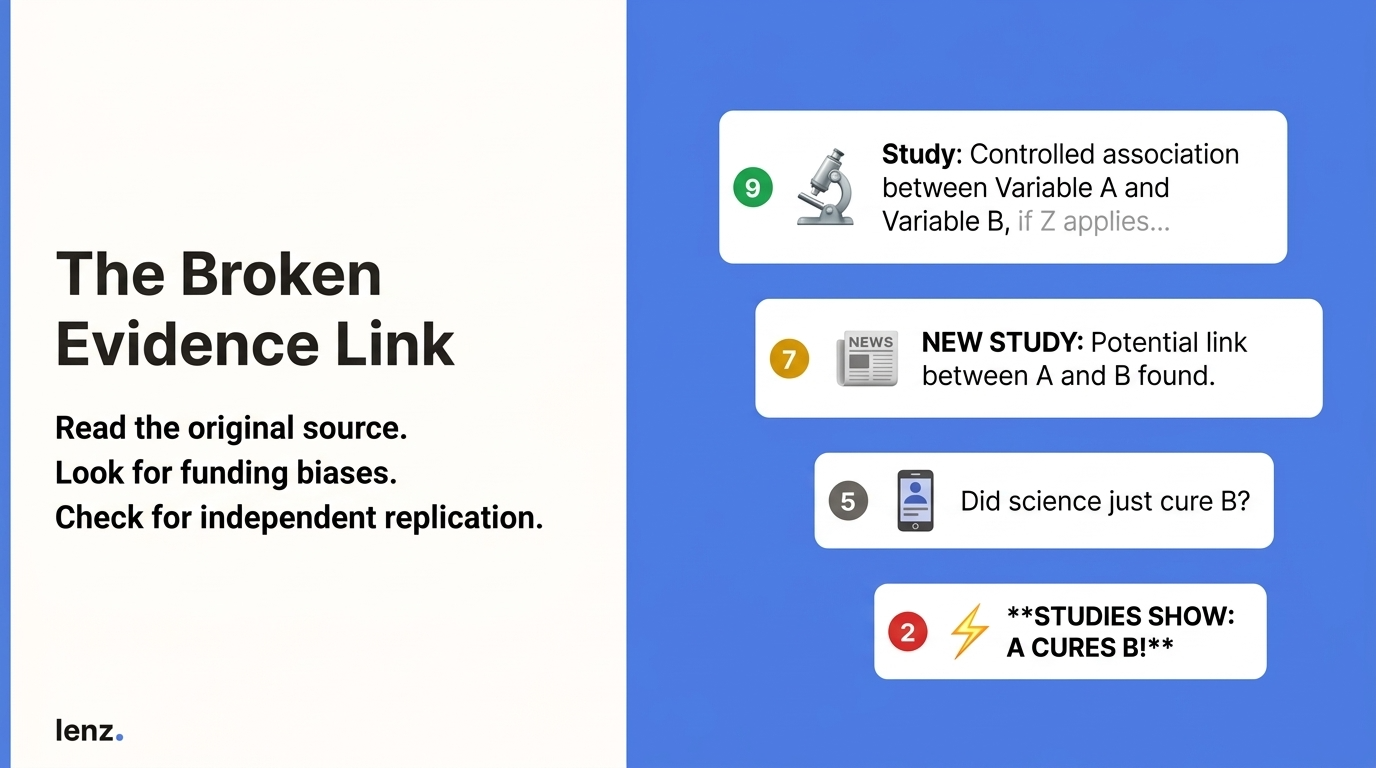
A study is published. A press release is written. Journalists cover the press release, not the study. Articles cite the journalism, not the study. Blogs cite the articles. Social posts cite the blogs. Five years later, someone writes "studies show" and links to a Medium post from 2019.
At each step, the original source gets further away. The nuance disappears. The hedges come off. The claim gets cleaner and more absolute — and therefore more shareable.
Case study: The Stretching Myth That Outran the Evidence
For decades, static stretching before exercise was standard protocol. Physical education classes taught it. Coaches prescribed it. It appeared in public health guidance worldwide.
The claim: Stretching before exercise prevents muscle soreness and injuries → Verdict: False.
The research basis was always weak — mostly observational, rarely using controlled designs. Starting in the late 1990s, studies began finding that static stretching before exercise could reduce muscle power output. By the 2000s, the evidence was shifting clearly. Major sports medicine bodies updated their guidance.
But the message had already propagated too far. Embedded in school curricula, fitness apps, workplace wellness programs, and popular books. The citation chain behind it was enormous — not because each link was solid, but because each link was citing the previous one.
Case Study: Collagen Supplements and the Industry-Funding Problem
Take collagen supplements — one of the most-purchased supplement categories globally, with a $6B+ annual market. When we examined the research on collagen for non-cosmetic outcomes (joint health, gut health, athletic recovery), a recurring pattern emerged: studies reporting benefits were frequently small, short-duration, and conducted by researchers with financial ties to supplement manufacturers.
The scientific literature on collagen supplements is not a robust, independent body of evidence that later attracted industry attention. In many cases, the dynamic runs the other way: industry-funded research gets cited as though it were independent validation.
The propagated claim: "Studies show collagen supplements support joint health." That sentence appears across thousands of product pages and health articles. The citation chain behind it is often a handful of manufacturer-funded trials with no independent replication. This is not a fraud problem. It is a structural problem in how health claims propagate — and why source quality matters as much as source existence.
A Research Checklist for Writers Who Cite Studies
Before you write "studies show":
- Click through to the original study. Not the article. Not the press release. The actual paper.
- Check the sample size and duration. A 6-week study of 40 people is a signal, not proof of anything.
- Look at who funded it. Industry-funded research isn't automatically wrong — but it is a material fact that belongs in your analysis.
- Search for independent replication. Has the finding been reproduced by researchers with no financial stake in the outcome?
- Read what the authors actually concluded. "Associated with" is not "causes." "In this population" is not "in humans generally."
- Check the publication date. A 2004 nutrition study may have been superseded by two decades of subsequent research.
The claim shouldn't just have a source. The source should be able to withstand scrutiny.
Lenz is a research verification platform, not a health authority. The analyses linked in this article were generated by Lenz's structured verification process: evidence is mapped from primary sources, competing interpretations are examined, and conclusions reflect the current state of available research — not editorial opinion. Lenz does not provide medical advice, dietary recommendations, or clinical guidance of any kind. Nothing on this platform should be interpreted as a substitute for professional medical consultation. If you are making health-related decisions, consult a qualified healthcare professional.
Our role is process: helping writers, researchers, and curious readers trace claims back to their evidence — and understand what that evidence actually says.