What 400+ Verified Claims Reveal About Misinformation
Contents
- We've now run more than 400 claims through the Lenz pipeline — structured research, multi-model debate, adjudicated verdict with cited sources.
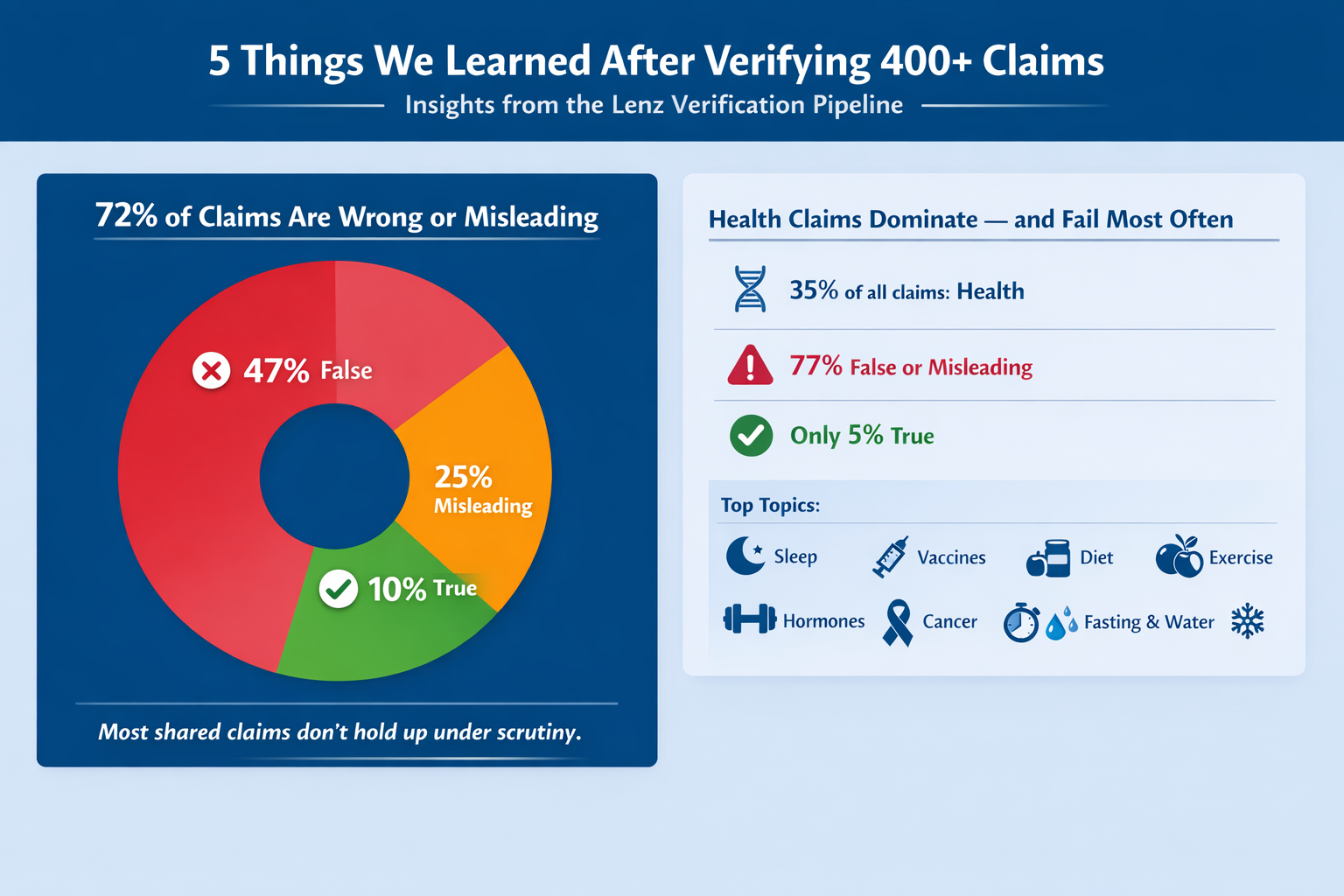
- Nearly 1 in 2 claims are simply false.
- Health is the most-questioned domain — and the least accurate.
- "Mostly True" is the most dangerous verdict.
- The gap between headline and abstract is where most misinformation lives.
- Certainty and accuracy are inversely correlated in popular claims.
We've now run more than 400 claims through the Lenz pipeline — structured research, multi-model debate, adjudicated verdict with cited sources.
Here's what the data shows.
Nearly 1 in 2 claims are simply false.
Not misleading. Not nuanced. Just false.
47% of claims we've verified came back False. Another 25% came back Misleading — meaning they contain real elements, but are framed in ways that distort meaning or omit critical context. Combined: 72% of the claims people circulate with confidence are wrong or misleading. Only 10% were fully True.
This isn't a sampling bias toward fringe content. We verify claims that people are actively sharing, citing, and debating — things that appear in published articles, professional presentations, and everyday conversation.
Health is the most-questioned domain — and the least accurate.
35% of all claims we've received are health claims. That's more than science, tech, politics, and finance combined. Within health: 77% are False or Misleading. Only 5% of health claims we've verified are fully True. The ten most-verified health topics: sleep, vaccines, supplements, diet/nutrition, exercise, hormone treatments, cancer risk factors, fasting, water intake, and cold exposure. In all of them, False or Misleading verdicts outnumber True.
"Mostly True" is the most dangerous verdict.
18% of claims came back Mostly True — meaning the core fact is accurate, but important context is missing, or the framing implies something the evidence doesn't support. People treat Mostly True as True. They cite it, share it, and build arguments on it — without carrying forward the qualifiers that make it defensible. Mostly True claims that circulate without context can be harder to correct than outright false ones — because they're harder to correct. The truth is in there somewhere, which makes the framing feel legitimate.
The gap between headline and abstract is where most misinformation lives.
The headline adds certainty the study doesn't claim. It removes qualifiers the authors were careful to include. It generalizes from a specific population to "humans." It converts "X was associated with Y under conditions Z" into "X causes Y." We've verified dozens of claims where the original research is legitimate — but the public version is False or Misleading because of what was added and removed in transmission. The study is real. The claim is not.
Certainty and accuracy are inversely correlated in popular claims.
Some of the most confidently-repeated claims in our database:
The average human attention span is shorter than that of a goldfish.False
The Great Wall of China is visible from space with the naked eye.False
Humans use only 10 percent of their brain capacity.False
It takes exactly 21 days to form a new habit.False
Stretching before exercise prevents muscle soreness and injuries.False
Drinking eight glasses of water per day is the optimal daily water intake for human health.False
Quantum computers are capable of breaking all currently used encryption algorithms.False
These aren't fringe conspiracy theories. They're things stated as facts in professional presentations, health apps, and science journalism. A clean, confident, widely-repeated claim is a reason to check — not trust.
About Lenz
Lenz is a research verification platform, not a subject-matter authority. The analyses in this article reflect structured evaluation of available evidence — not editorial opinion or professional guidance. Nothing in this article should be interpreted as medical, legal, or professional advice. For any domain-specific decisions, consult a qualified professional.
Our role is process: helping writers, researchers, and curious readers trace claims back to their evidence — and understand what that evidence actually says.